

The Angora goat is a unique and ancient breed, known for its long, curly fleece called mohair. They are highly valued for their luxurious fiber, which has been sought after for centuries due to its softness, luster, and strength. In this post, we will be going over their history, breed characteristics, color varieties, and more.
QUICK FACTS
Female goats: Does Baby goats: Kids Intact males: Bucks Castrated males: Wethers
- Angora goats are not sheep.
- Produce mohair, a silky luxurious fleece.
- General Temperament: Calm, quiet, and friendly.
- Lifespan: 10-15 years.
- Thrive in a variety of climates.

History and Origins of the Angora Goat
Angora goats are a unique and ancient breed of goat that is surprisingly not very well known. However, there is a reason you never see an Angora goat pictured on goat feed bags or in goat calendars. If they were, everyone would think somebody had messed up and put a sheep on there! This is because Angora goats are fiber goats. They are not bred for meat or milk. They are a single-use animal and their sole purpose is to produce mohair. Mohair is known as the “diamond fiber” due to its lustrous quality and strength.
Angora goats hail from the Anatolian Plains of Turkey and are named after the Angora province. They have been raised in Asia Minor for at least 3,000 years and are even mentioned in the Bible! In Exodus 25:4, the angora goat’s fine, silky hair is used to weave the Tabernacle’s curtains. Since Angora goats were so valued and prized for their mohair, they were heavily gate-kept for centuries. The earliest record of Angora goats in Europe was in 1531 when the Dutch Ambassador incredibly obtained a pair while stationed in Constantinople (Goat Breeds: Angora, n.d.)
The Sultan of Turkey first allowed the raw export of mohair from Turkey to Europe only 205 years ago! This export allowed the world access to mohair like never before and the United Kingdom ran with it, swiftly mastering the art of spinning mohair. Thus, the supply and demand for mohair became too great for Turkey to sustain. So, only 49 years after that first export of mohair, the first Angora goats arrived on the sandy shores of South Carolina to a cotton farmer as a gift for helping Turkey cultivate cotton (Goat Breeds: Angora, n.d., Masterclass, 2021).
The popularity of Angoras spread across the world like wildfire with the largest populations settling in Texas, South Africa, and Australia. From the 7 does and two bucks that arrived in the United States over 175 years ago, to the 105,000 that continue their legacy, angora goats continue to rise in popularity here in the U.S. (USDA Texas Goat and Mohair, 2024). Thus, Angora goats are a dichotomous blend of old and new, being a living echo of the past and a new hope for the fiber artist’s future.

Angora Goat Fiber and Shearing Practices
As you now know, Angora goats are fiber goats. Now it would be very simple if their fiber was called angora instead of mohair but the Angora rabbit claimed it first. Just kidding! Actually, the term “mohair” is very old and comes from the Arabic word “mukayyar” which literally means “choice” or “select” (Oxford Languages, 2024). Mohair is not wool or cashmere but actual hair. It is very distinct and when blended with other fibers, adds unprecedented luster, strength, and softness.
Mohair grows an inch a month so Angoras need to be shorn twice a year. The optimum working length for fiber mills is 6 inches. Less than 4 inches is too short to work with. Over 6 inches is used for custom crafting like dollhair and Santa beards. Climate determines shearing seasons. In the northern climates, shearing is done in the spring and fall while in the warmer climates, shearing is completed in January and June. We live in the Northern Rockies of Idaho and depending on the weather, shear mid-March and mid-September.
While Angoras and sheep are often labeled as one and the same, that could not be further from the truth. They are different species, require different diets, and should be shorn differently as well. Angoras characteristically have loose skin, often rolls of it. More skin equals more mohair production. Because of this, if they are sat down and rolled around like sheep, they can be easily cut. Mohair also comes off in ringlets, unlike wool which comes off in a matt. An adult Angora goat can produce between 8-10 pounds of mohair per shearing.

Size and Temperament in Angora Goats
Compared to other goat breeds such as the Boer goat (largest goat breed) and the Pygmy goat (smallest goat breed), the Angora goat falls conveniently in the middle. They are more fine-boned than Boer goats as everything is poured into the production of mohair. Adult Angora bucks weigh an average of 175-220 lbs and the adult does weigh an average of 130-150 lbs. They generally live between 10-15 years.
Now our Angora goats here at Red Falcon Ranch are some of the largest in the country as we breed for strong, powerful bodies. Like any true artisan, we believe that the foundation on which something is built (or grown in our case) is a reflection of the finished product.

Spicy or Sweet?
When you think of the personality of goats, do you think of radical scallywags jumping on the mailman’s car or unpredictable beasts that you dare not turn your back on? Well, Angoras continue to balk at the stereotype of goats! From looking like sheep, to not stinking to high heavens, to having the personality of dogs, Angora goats are truly unique. They are incredibly chill and relatively quiet. They enjoy human interactions such as snuggles and going for walks.
Like all mammals, behavior is greatly dependent on how they were raised. Wonderful personalities and respectable behavior is a priority for us here at Red Falcon Ranch. Angora goats are naturally non-aggressive goats. We train our bucks to walk on a leash and they are respectful while also sweet and friendly. Our bucks are never intentionally aggressive with their horns towards us shepherds. The does are naturally more cautious than the bucks, but once they get over their “stranger danger”, they are equally sweet.
Horn Characteristics in Angora Goats
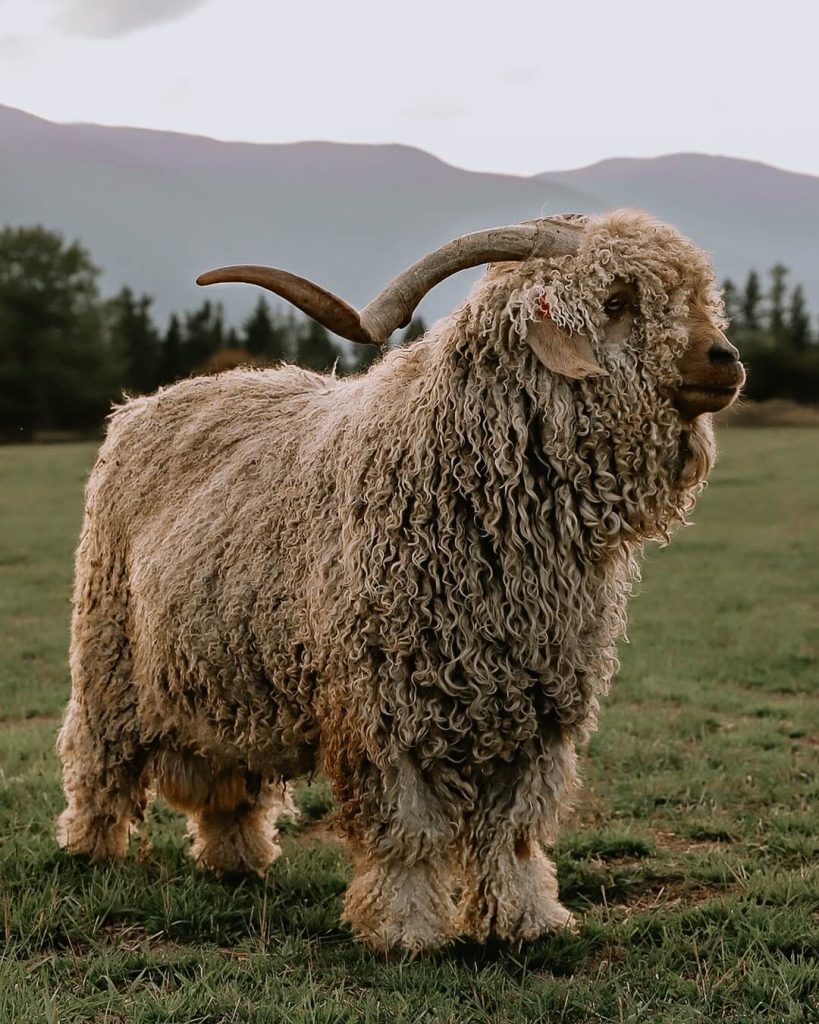
While mohair is certainly the most unique feature of the Angora goat, another unique trait are its horns. This is more specifically seen in the adult bucks as their horns never stop growing. As their horns grow out and away from their skull, they begin to twist in a spiral pattern (Hayes, 1868). Thus creating a spectacular hornset that can be four feet long from tip to tip. Horns are vital to Angora goats as it is not only a part of the breed standard but critical for temperature regulation.
Due to the production of mohair, Angora goats become heavily insulated. Mohair itself is temperature regulating otherwise the goats would not be able to live to produce it. However, other extremities in the body help to alleviate the heat during the summer. This is where the horns come in. Horns are highly vascular and, through passive heat transfer, are an avenue for heat loss (Scholander et al.,1950). This allows the goats to not overheat during the warm months. It also keeps the blood cool around the brain which is important for basic functions (Taylor, 1966).

Angora Goat Color Varieties
Historically, angora goats were only bred for the color white. If any other recessive color popped up, it was immediately culled due to being “impure” (Ronan, 2024). White mohair is also the easiest to work with in mass quantities due to its consistency. There’s no varying shades of white like there is with every other color or pattern. For the most part, the large ranches in Australia, South Africa, and Texas hold true to the fundamental tradition of only breeding for white.
However, after veritable centuries of trying to eliminate color from the angora goat, colored angoras could not be stomped out. Shockingly, only in this last century have colored angora goats become popular. With the desire to return to a natural way of life, natural fibers have become more favored, and naturally colored fiber is finally having its time to shine. Some breeders began seeking out the unwanted colored angoras from the large ranches while others took matters into their own hands. This resulted in the intentional cross-breeding of dairy and meat breeds with Angora goats. While this brought in much color and pattern, the quality of mohair deteriorated. There needed to be a standard for the Colored Angora goat to promote color and mohair. Thus, the Colored Angora Goat Breeders Association (CAGBA) was established in 1999.
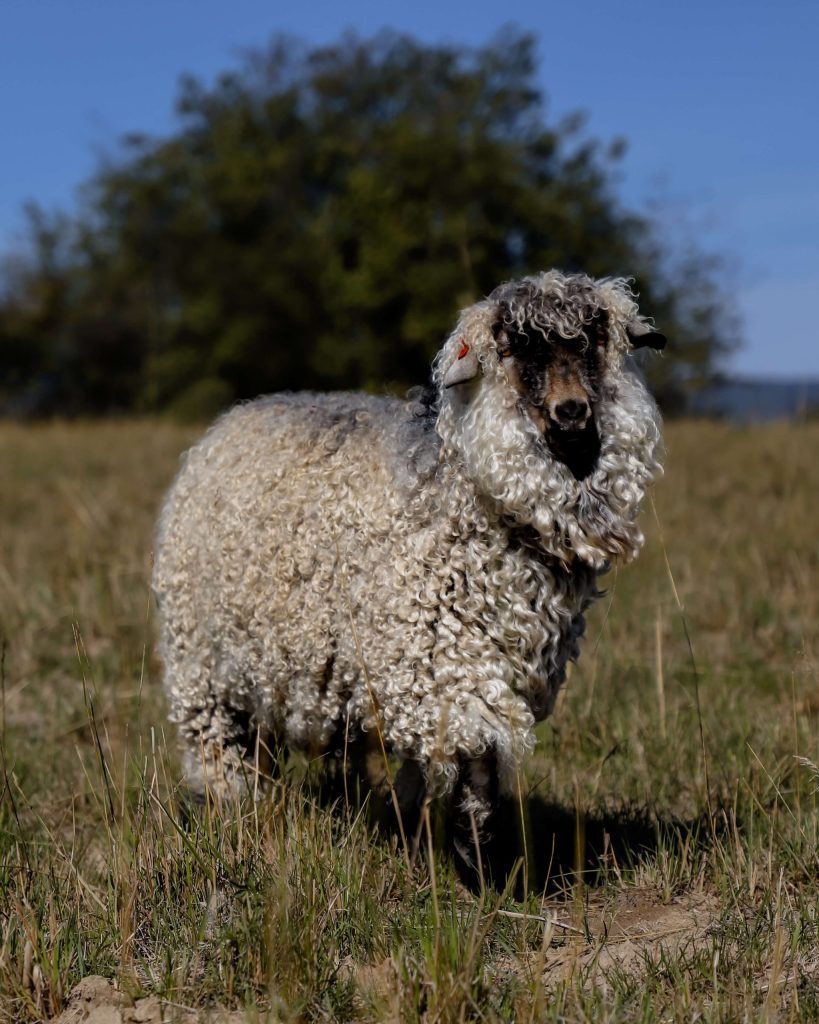
It is quite incredible to think that for thousands of years, colored angoras experienced a veritable genocide only to come back stronger than ever. Nowadays, angora goats can come in a rainbow of colors ranging from dark reds to creamy golds to silvery blues to deep blacks and chocolatey browns. And that’s just the solids! There is also an unlimited number of patterns including badgers, peacocks, darkbellies, lightbellies, and pintos. The color genetics of colored angora goats is a literal science all its own as it is different from any other goat breed.

Breeding and Care for Angora Goats
The gestation period for Angora goats is 145-155 days with the average being 150 days (Stewart, 2021). Angora goats usually have a single or twins, rarely triplets. This is dependent on the size of the goat, nutrition, and genetics. However, Angora goats are not dairy goats and only produce enough milk for their offspring. Additionally, their udder has only two teats. When one of our does has triplets, we bottlefeed at least one of them as there is not enough milk for all three, and it can put too much stress on the mom.
Angora goats are slow-growing as most of their energy is put into fiber production. They do not reach sexual maturity until two years of age and we do not breed until they are at least four years old to allow their bodies to fully grow and mature. Does go into estrous heat every 21 days approximately (Steward, 2021). Due to our climate here in the northern Rockies, we breed in November so our kidding season is in April. This way we are not having kids during the cold, snowy months and allow the kids to have a solid start before the months start turning cold again.
The End…
So, from being immortalized in the pages of ancient texts to being kept under lock and key to crossing vast oceans to multiple continents, Angora goats have experienced a history almost as unique as themselves. They are wholly unique unto themselves despite being constantly misnomered and confused for other species. The Angora goat is a true treasure that continues to become a phenomenon throughout the fiber world.
Bibliography
- Lord Hayes, J. (1868). The Angora Goat: Its Origin, Culture, and Products (Vol. 11). : A.A. Kingman.
- Taylor, C. R. (1966). The Vascularity and Possible Thermoregulatory Function of the Horns in Goats. Physiological Zoology. https://doi.org/10.1086/physzool.39.2.30152426
- Scholander, P. F., Hock, R., Walters, V., & Irving, L. (1950). Adaptation To Cold In Arctic And Tropical Mammals And Birds In Relation To Body Temperature, Insulation, And Basal Metabolic Rate. The Biological Bulletin. https://doi.org/10.2307/1538742
- Stewart, J. L. (2021, August). Pregnancy in Goats. Merck Manual Veterinary Manual.
- Stewart, J. L. (2021, August). Puberty and Estrus in Goats. Merck Manual Veterinary Manual.
- Mannion, B. (n.d.). Goat Breeds: Angora. New South Wales Government. https://www.dpi.nsw.gov.au/animals-and-livestock/goats/breeds/angora#:~:text=Origin,when%20many%20flocks%20were%20dispersed.
- Ronan, C. (2025). Origins of Angora Goats. Ronan Country Fibers. https://ronanfibers.com/history-of-angora-goats/
- Texas Goat and Mohair. (2024, January 31). United States Department of Agriculture National Agricultural Statistics Service. https://www.nass.usda.gov/Statistics_by_State/Texas/Publications/Current_News_Release/2024_Rls/tx-goat-2024.pdf